The Policy Portfolio Framework
How institutional investors define a target allocation — and the simple logic you can apply to your own balance sheet without a consultant.


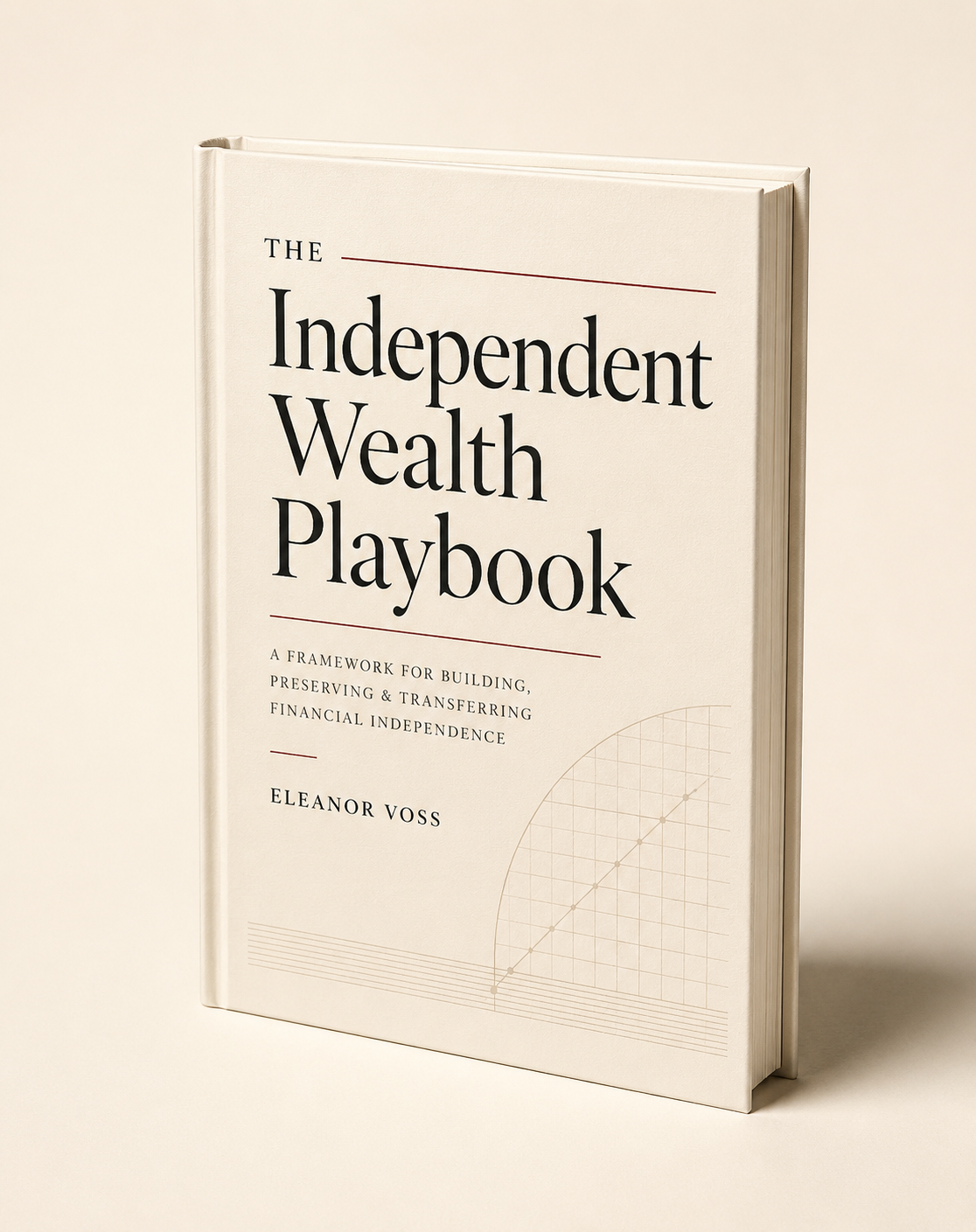
The Independent Wealth Playbook
168 pages of institutional-grade portfolio thinking — written for self-directed investors who are done paying someone else to manage decisions they can make themselves.

Editorial · The self-directed investor's dilemma
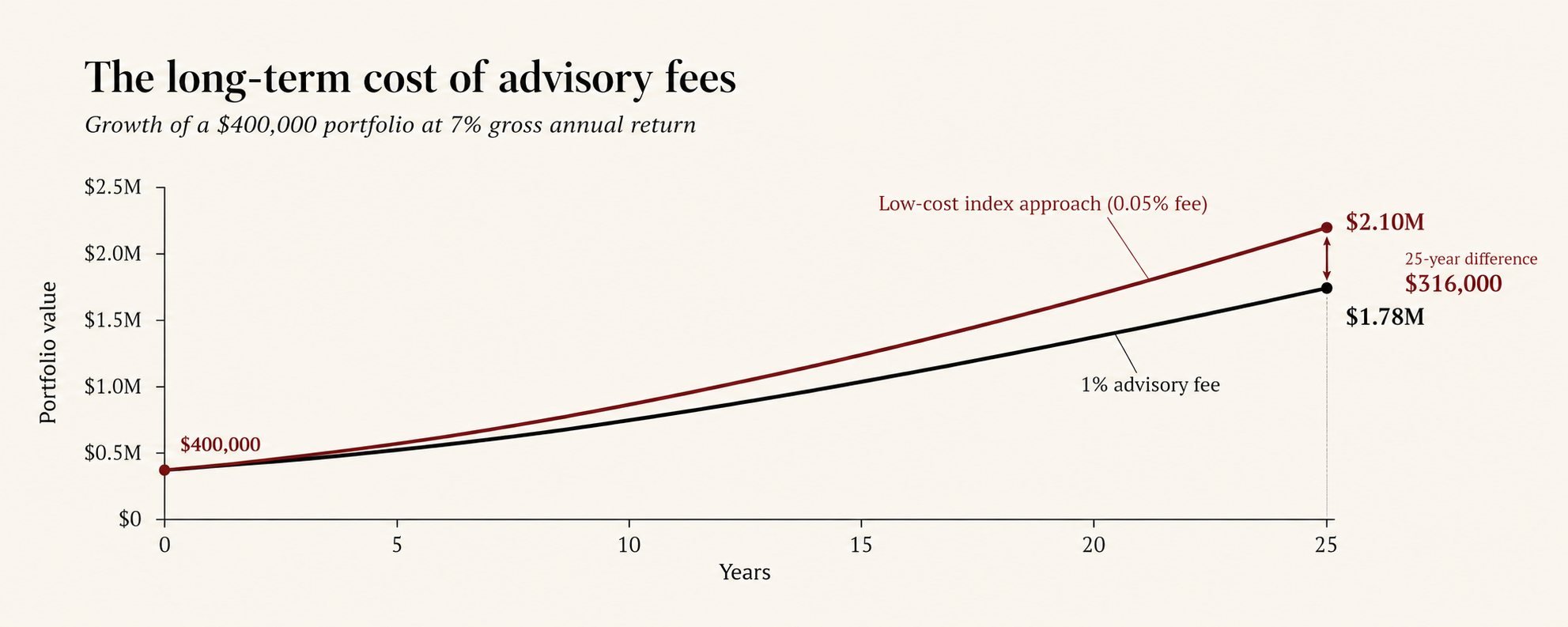
Most investors know, in a vague way, that fees matter. What most people fail to reckon with is the compounding arithmetic of a seemingly small 1% annual advisory fee applied over a 25-year accumulation horizon. On a $400,000 portfolio, that fee doesn't cost you $4,000 a year — it costs you somewhere between $280,000 and $350,000 in foregone terminal wealth, depending on your return assumptions. That is not a rounding error. It is a second retirement account that quietly evaporates every year while the statements keep looking polished.
The financial advisory industry has built an extraordinarily durable business model on a single insight: complexity is profitable. The more opaque the decision-making process appears, the more willing clients are to outsource it — and to pay a perpetual toll for the privilege. The language of "holistic planning," "risk-adjusted allocation," and "rebalancing discipline" is not wrong, exactly. But for a large share of self-directed investors with straightforward balance sheets and reasonable time horizons, the intellectual substance behind that language is considerably thinner than the fee implies.
The uncomfortable truth is that the core framework behind institutional portfolio construction is not secret. It is documented, reproducible, and learnable. The principles that govern asset allocation at endowments and pension funds — liability matching, factor exposure, tax-location, rebalancing bands — have been in the academic literature for forty years. What is scarce is not the knowledge. What is scarce is a plain-language synthesis of it that a thoughtful non-professional can act on without a Bloomberg terminal or a team of analysts.
That synthesis is what this playbook is. Not a philosophy lecture, not a product pitch dressed as research — a working framework, tested against real portfolio scenarios, written by someone who spent fifteen years on the institutional side watching advisors charge retail clients for services that rarely justified the cost.
The endowment model that David Swensen pioneered at Yale in the 1980s became the dominant template for institutional investing over the following three decades. Its core insight — diversify across uncorrelated return streams, tilt toward illiquidity where you can afford to, and minimize the tax and fee drag that bleeds returns at the margin — remains sound. What got lost in translation to the retail world is the simplicity of the underlying logic.
Institutions don't rebalance constantly. They don't chase the best-performing fund from last quarter. They don't fire their asset managers the first time a strategy underperforms for eighteen months. They set a policy allocation with clear rationale, they define rebalancing bands, and they execute with low-cost instruments. The sophistication is in the design, not in the continuous activity. Continuous activity, in fact, is the enemy of returns — it generates fees, taxes, and behavioral errors.
"The single biggest threat to long-term wealth accumulation for the self-directed investor is not market volatility — it is the cumulative drag of fees and behaviorally-driven trading that looks like discipline." — Dr. Priya Nambiar, behavioral finance researcher, London School of Economics
Howard Marks of Oaktree Capital has argued for years that the best investors are distinguished not by what they do but by what they refuse to do: refuse to chase momentum, refuse to abandon a strategy during its inevitable drawdown, refuse to mistake activity for alpha. His memos — freely available and among the best free financial education on the internet — make the same argument in different clothes with each market cycle.
Similarly, Cliff Asness at AQR has written extensively about factor investing: the evidence that value, momentum, quality, and low-volatility exposures have historically generated excess returns over long periods, not because markets are irrational but because of the genuine behavioral and structural frictions that make these premia persist. The point is not to time the factors. The point is to get systematic exposure to them and hold on.
The historical parallel that clarifies this period is the shift in corporate pension management that occurred in the 1990s. As defined-benefit plans came under sustained pressure from both market volatility and fee erosion, the pension management world was forced to confront an uncomfortable finding: a significant proportion of active management underperformed passive alternatives net of fees over rolling 10-year periods. The response was not to abandon all active management, but to raise the bar substantially for what justified active fees. The retail market has been slower to internalize the same lesson — but it is internalizing it now.
Today, Vanguard manages approximately $9.3 trillion in assets. Fidelity's index lineup holds another $2.8 trillion. BlackRock's iShares platform accounts for roughly $3.5 trillion in ETF assets. These are not numbers that suggest fringe adoption of a theory. They represent a structural shift in how serious long-term investors — including institutional investors with full access to alternative strategies — have voted with their capital over the past two decades.
If you'd like the full framework — including specific allocation templates for different net worth tiers, tax-location strategy, and the fee-audit process we walk through chapter by chapter — download The Independent Wealth Playbook here. It's a 168-page guide built from fifteen years of institutional and advisory practice, designed to be read once and referenced for years.
None of this means that fee-bearing professional advice is never worth its cost. For certain planning complexities — estate structures, business transitions, concentrated stock positions, multi-generational wealth transfer — the value a skilled advisor provides can genuinely exceed their fee. The argument is not that advisors are useless. The argument is that for a large share of investors with straightforward situations and the willingness to learn, the advisory relationship is a product sold on the premise of complexity that doesn't actually exist. Knowing which category you fall into is itself a meaningful financial decision.
The investors who have done best over the past generation share a common trait: they understood their own situation clearly enough to know when they needed advice and when they didn't. They built a policy framework, they stuck to it through market cycles, they kept their costs low, and they avoided the behavioral pitfalls that undermine most retail portfolios. That is not a complicated formula. It is a disciplined one — and discipline, unlike complexity, is something you can learn.
How institutional investors define a target allocation — and the simple logic you can apply to your own balance sheet without a consultant.
Which asset classes deserve a place in a self-directed portfolio, which are marketing products dressed as diversifiers, and how to tell the difference.
The single highest-leverage, lowest-risk improvement most retail investors never make: putting the right asset in the right account type.
A step-by-step audit of every cost in your portfolio — fund expense ratios, advisory fees, trading friction — with the exact math to quantify the lifetime impact.
When to rebalance, how much drift to tolerate, and why calendar-based rebalancing typically underperforms threshold-based approaches over long periods.
The evidence-based case for value, quality, and low-volatility tilts — and how to implement them without adding meaningful cost or complexity.
The five behavioural patterns that destroy most retail portfolios over time — and the structural rules you can set in advance to prevent them.
Three full allocation templates (conservative, balanced, growth-tilted) with implementation notes, fund recommendations, and a maintenance checklist.
$39 · Instant download after payment
Get the Playbook
Questions from real buyers
I've been investing for about eight years. Is this going to be too basic for me?
If you've been investing for eight years and you can articulate your rebalancing policy, your tax-location logic, and your annual fee total — you might already know this material. But most people who've been investing for a decade have accumulated positions without a coherent framework beneath them. If that's you, chapters 1–4 will be new. If you're further along, chapters 5–8 on factor tilts and behavioural guardrails tend to be where more experienced investors find the most value.
What format does it come in, and how do I get it?
It's a PDF, 168 pages, formatted for both screen reading and printing. After payment, you'll receive an email with your download link within seconds — the link doesn't expire. You can read it on any device and save it however you like.
What's your refund policy? I've been burned buying financial books that turned out to be fluff.
Completely fair concern. 30-day money-back guarantee, no questions asked. Email [email protected] within 30 days of purchase with "Refund request" in the subject line and you'll have your money back within two business days. I'd rather you not buy it than buy it and feel you wasted $39. See the full refund policy here.
Does this apply to non-US investors? I'm based in Europe.
The portfolio construction frameworks in chapters 1–7 are entirely jurisdiction-agnostic — asset allocation, rebalancing, behavioural guardrails, and factor logic don't change based on where you live. The tax-location chapter (Chapter 3) uses US account structures as the worked example, but I include a section explaining the analogues in UK, EU, and Australian tax-advantaged accounts. About 30% of buyers are outside the US and the feedback has been consistently positive on applicability.
What readers did with this
Before
Four index funds, an old 401(k) from a previous employer, and a brokerage account with individual stocks accumulated with no underlying logic. Annual advisory fee of 0.85% on the managed portion. No idea what the combined fee total was.
After
Consolidated into a three-fund core across two account types with explicit tax-location logic. Ran the fee audit and eliminated $4,200 in annual advisory costs. Set rebalancing bands and a quarterly review calendar.
"I spent a weekend with the playbook and a spreadsheet. By Sunday evening I had a clear picture of every cost in my portfolio, a consolidated allocation I could actually explain to my spouse, and a maintenance process that takes about two hours a year. The fee audit chapter alone was worth ten times what I paid. I had no idea my old advisor was extracting that much — and it wasn't even in a form I'd ever complained about because it just showed up as a lower return, not a line item."
James ThorntonOperations manager, 41, Portland OR
Individual results vary. Reader outcomes and case studies shown reflect personal experience and are not guarantees of similar results for other buyers.
Get the Playbook
168 pages of institutional-grade portfolio thinking — the allocation logic, the fee audit, the rebalancing discipline, the behavioural guardrails. Written once, referenced for years.
The Independent Wealth Playbook
PDF · 168 pages · Updated May 2026
$39
Get the PlaybookNot personalised investment advice. Educational content only. Refund policy.
Educational content. Not personalised investment advice.
WealthIndependent publishes educational content for self-directed learners. Nothing on this site or in our products constitutes personalised investment, legal, or tax advice. All investments involve risk, including the possible loss of principal. Past performance is not a reliable indicator of future results. You should consult a qualified financial professional before making any investment decision that affects your specific situation. Reader outcomes and case studies shown on this page reflect individual experiences and are not guarantees of similar results. By using this site you agree to our Terms of Use, Privacy Policy, and Refund Policy.
Individual results vary. Reader outcomes and case studies shown on this page reflect their personal experience and are not guarantees of similar results for other readers.
Ayvalenn LLC · 1966 Barron Lane, Fort Worth, TX 76112
Step 1 of 2 — Your details
The Independent Wealth Playbook
PDF · 168 pages
$39
Step 2 of 2 — Payment
The Independent Wealth Playbook
PDF · 168 pages
$39
Your download link has been sent to
Order
The Independent Wealth Playbook
PDF · 168 pages
$39
If you don't see the email within 5 minutes, please check your spam folder or contact [email protected].
Continue browsingEffective date: June 15, 2026
Ayvalenn LLC offers a 30-day money-back guarantee on all digital products.
Any purchase of The Independent Wealth Playbook is eligible for a full refund within 30 days of the original purchase date. No reason required — if the product isn't right for you, we will refund you in full.
Email [email protected] from the email address used for the purchase, with "Refund request" in the subject line. Include your order ID if available. We will confirm receipt within 1 business day and process the refund within 2 business days.
Refunds are issued to the original payment method. Depending on your bank or card issuer, funds typically appear within 5–10 business days of processing.
Purchases older than 30 days are not eligible for refund. Bulk or corporate orders may be subject to separate terms agreed in writing at the time of purchase.
[email protected] · 1966 Barron Lane, Fort Worth, TX 76112